| This week, a new multimedia collection that focuses on diverse voices from the fashion industry. Plus, business travelers start to hit the road again, and questions for Infarm CEO Erez Galonska on his vision for changing the way people eat. |
|
|
|
| The fashion industry has a diversity problem. Certain groups of talented individuals—in particular, people of color—struggle to break into the industry, and those who manage to get in don’t often feel welcome. This lack of diverse talent begins in fashion schools and internships and continues through the industry into its highest echelons of power and influence. |
| What’s to be done? Much. Change is needed throughout the broader fashion ecosystem, and it will take individuals, companies, and institutions all stepping up and doing their part. Because, as an emerging designer put it: “You, me, any person of color living their life, making their art—that should be important every day. Because we live every day, and we exist every day.” |
| A more equitable and inclusive fashion industry is within reach, and the opportunities to make it so are plentiful: from discussions that lead to action through early interventions and long-term mentorship programs to tools and resources, training and funding. In late 2020, McKinsey conducted research that included more than 1,000 working industry professionals across 41 companies, 20 stakeholder interviews, and three focus groups with students and emerging designers. The data revealed several hurdles: |
| In fashion schools, students of color said they have experienced a range of microaggression, such as overhearing disparaging remarks made by professors as their White counterparts looked on with indifference. These same White counterparts are able to bond with their professors and use those relationships to get internships and other opportunities, the students said. |
| Fashion internships are often unpaid—an enormous barrier to entry into the industry for low-income students. They’re also difficult to get, since they require networks or connections that some students may not have. “A lot of these jobs go to people because they know somebody at the company or because they have a bunch of networks,” one student said. “Why am I even wasting my time filling out this application?” |
| Awareness about and access to opportunities is another problem. As one industry leader told us, lack of awareness about an opportunity is difficult enough—but if students are aware of opportunities yet can’t access them, it can have a tremendous impact on their career “that’s even more torturous and detrimental.” |
| Nurturing talent. Fashion is a vibrant, thrilling, and ever-growing industry, and the students and young professionals we spoke with remain determined and focused. “There is talent,” one fashion student said. “We know, because it’s the world we live in.” |
|
|

|
| OFF THE CHARTS |
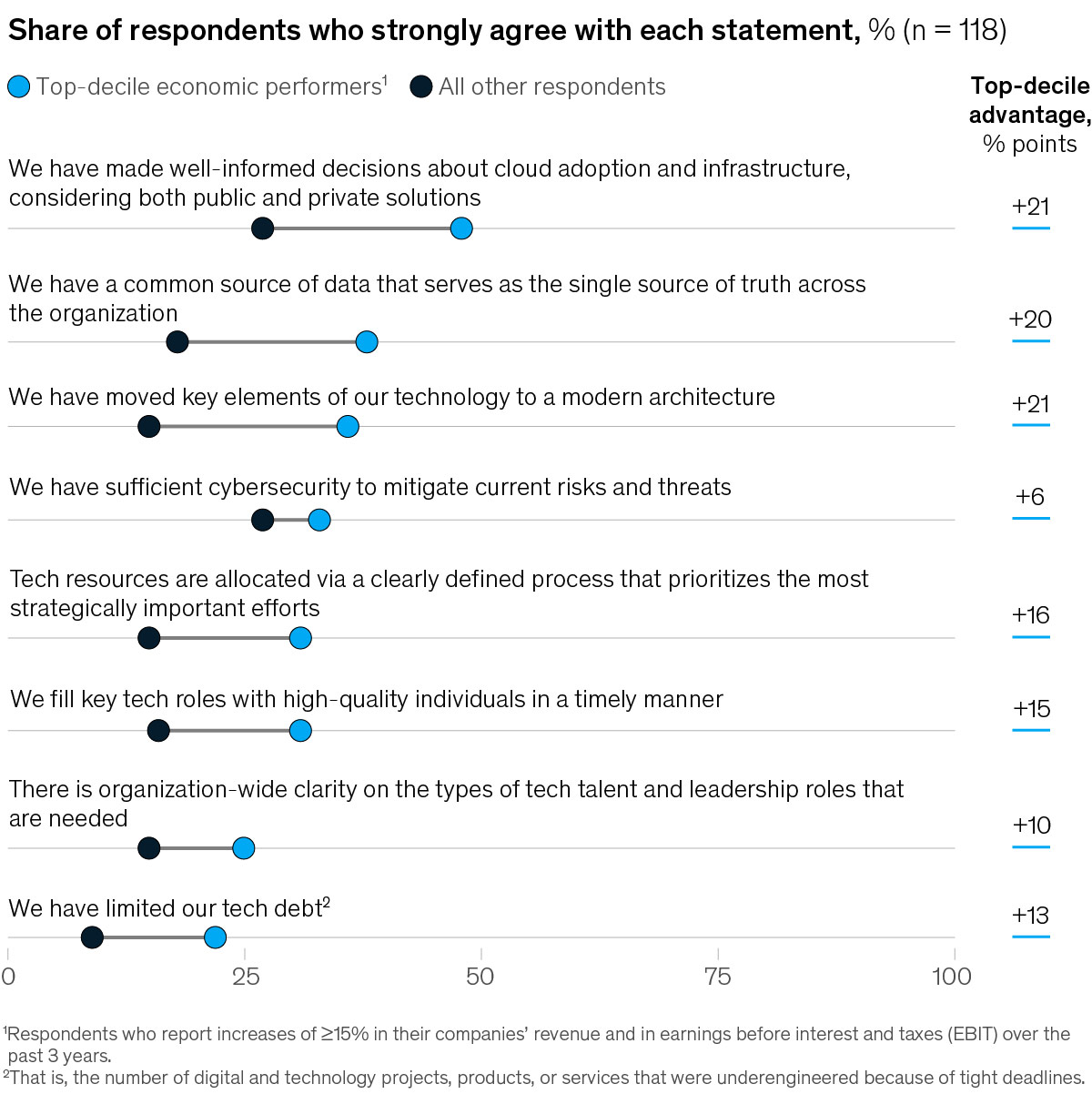
| The new digital edge |
| Companies that have invested in tech and digital over the years to build what we call a “technology endowment” are now significantly ahead of peers that dedicated less time, effort, and capital to the effort. |
|
|
|
|
|
|
| MORE ON MCKINSEY.COM |
| Corporate travel begins a comeback | As business travelers start to hit the road again, organizations can prepare by considering the archetypes of the future. We’ve identified four: the “never left,” the “never returning,” the “fear of missing out,” and the “wait and see.” |
| How COVID-19 has changed the way US consumers think about healthcare | The healthcare ecosystem would benefit from making care personal and convenient, using omnichannel methods to reach consumers and improving transparency to support decision making. |
| Forging a path for new Nordic champions | The Nordic region has been home to some of the world’s most lauded companies. But now, Nordic companies trail their global peers in growth and scale. Here are five moves they can take to recapture growth and market share. |
|
|
|
|
|
| FIVE QUESTIONS FOR |
| Erez Galonska |
| In an interview with McKinsey, Infarm CEO and cofounder Erez Galonska shares his vision for how to change the way people eat and reflects on what he has learned from bringing the Infarm food-production concept to 50 percent of the world’s largest food retailers.
|
|
|
|
|
| What was the motivation behind launching Infarm in 2013? |
| I have always been fascinated by self-sufficiency because, for me, it ultimately means freedom. So in late 2004, I started to explore what it really means to be self-sufficient. I looked at everything from how to become energy and water self-sufficient to growing my own food. |
| In 2005, I started traveling between different communities and was doing work in exchange for lodging. I did many types of manual work on farms, ranging from picking mangoes to growing vegetables. At the peak of this journey, I lived on a mountain in the Canary Islands and was living completely self-sufficiently. |
| During this time, I became obsessed with growing my own food and saw that it allowed me to try more interesting varieties that don’t make it through today’s industrialized supply chains. When I moved back to Berlin, I asked myself, “Why can’t I take my farming with me? Would it be possible to grow my own food without soil?” When I did my research on this topic, I encountered two things: first, there was a group of people who already farmed without soil as part of a movement called hydroponics; and second, I saw these utopian pictures of plant-covered skyscrapers in cities, which gave me confidence that I could change the way we source and eat food. This became the driving force to build Infarm. |
| How did you set up your first commercial farm? |
| You have to imagine hydroponics as an umbrella for lots of different techniques that we had to learn about. The outcome of this was that, in late 2016, together with a set of designers, mechanical engineers, and craftsmen, we built our first commercial farm in Berlin in Neukölln. |
| This first commercial farm also helped us to attract exceptional talent who were inspired by our purpose. At our food lab, employees could experience for themselves the potential of Infarm to change the way people eat: having access to fresh fruits and vegetables grown near the point of purchase without pesticides and customized to local diets. This shared purpose helped us through some early hardships, when we had little funding and could barely pay our first employees. Our purpose kept us motivated to keep going. |
| How did you make your first customers aware of Infarm? |
| Our first customer was somewhat unexpected: 25hours Hotels, an international hotel chain in Berlin. An architect visited our urban farm and was immediately excited to bring it to 25hours Hotels, an opportunity that we hadn’t thought of before. We visited the site, and then started doing research into how we could best bring our concept to the hotel chain. There had been success in growing plants on skyscraper rooftops, which gave us confidence that we could do the same with food production. We built a farm on the hotel’s rooftop and called it the Sky Farm. Word quickly spread, which helped us reach more customers. |
| When did you know that it was the right time to scale the business? |
| The CEO of one of the biggest wholesalers in Europe came to our Berlin food lab. We had worked together with a designer to render one of our farms inside a retail store for a demo. When the CEO saw this, he presented us with a challenge: he would close a deal on the spot if we were able to bring the Infarm concept to his retail locations. |
| We accepted the challenge and built our first farm in a supermarket. After three months, we launched the world’s first cloud-connected farm, where we use smart devices to gather data from the farm and apply analytics technologies to improve growing conditions, essentially creating a self-learning farm. This enables us to perfect our growing recipes and improve the yield, quality, and nutritional value of the food grown. When a video of the “farm in the supermarket” went viral, we received requests, mostly from retailers around the world, to build connected farms in their stores. |
| How do you see the future of agriculture in general? |
| Agriculture, from our perspective, is returning to its roots. I think that one of the biggest powers of technology is that we can again grow food where it is consumed. |
| A second big trend is personalization. Today, agriculture operates according to a push concept. Companies cultivate the crop and then try to get it to the consumers. At Infarm, we do the reverse: we leverage data to understand customer preferences and then grow the crop accordingly. We call it “personalized farming.” The future will be micro farms that cultivate crops based on households’ taste profiles, diets, and health needs. |
| — Edited by Justine Jablonska |
|
|
|
| BACKTALK |
| Have feedback or other ideas? We’d love to hear from you. |
|
|
|
|
Did you enjoy this newsletter? Forward it to colleagues and friends so they can subscribe too.
Was this issue forwarded to you? Sign up for it and sample our 40+ other free email subscriptions here.
|
|
|
Copyright © 2021 | McKinsey & Company, 3 World Trade Center, 175 Greenwich Street, New York, NY 10007
|
|
|
|